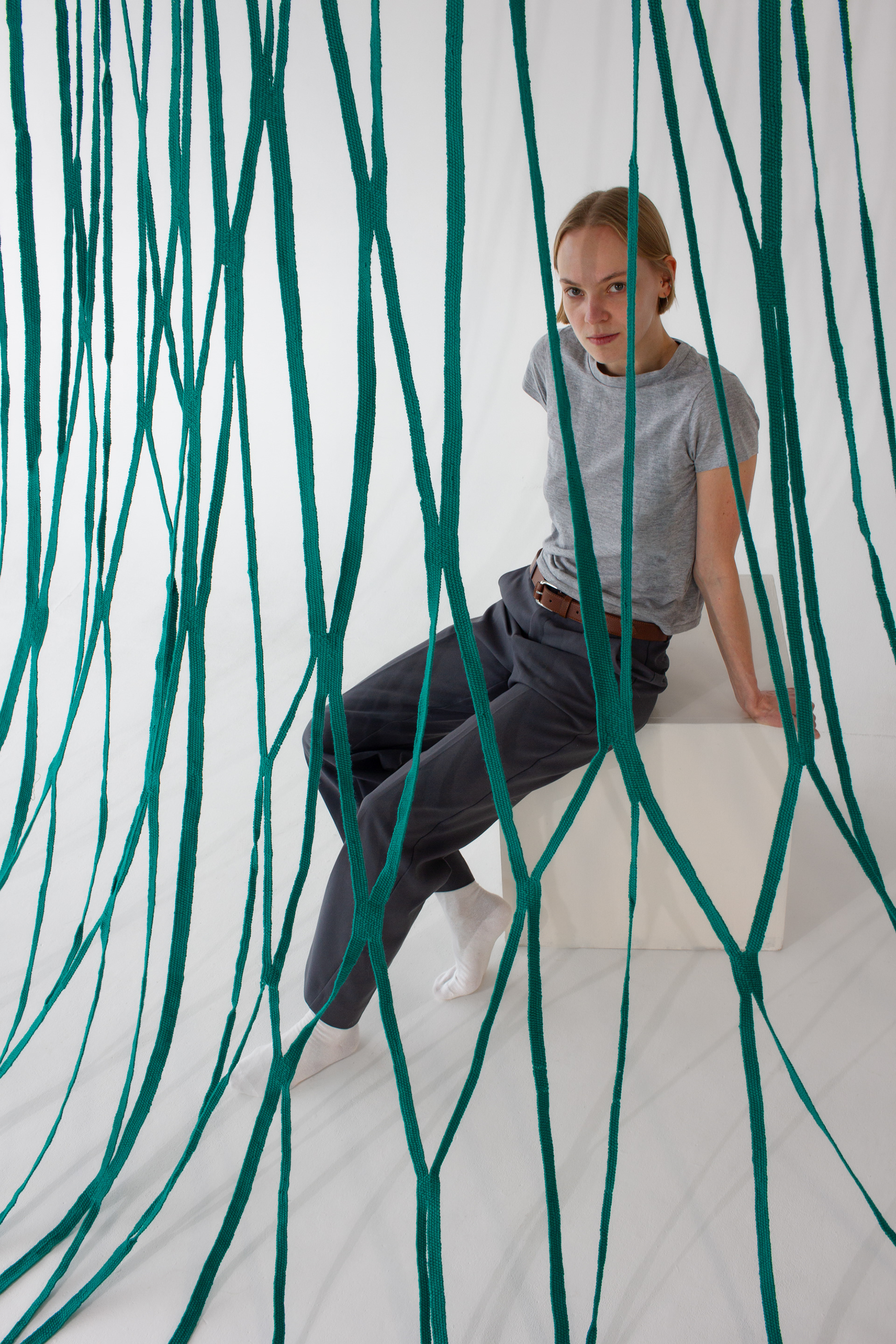
Biography
Natalia Semenova (b. 1997, Tolyatti, Russia) is a contemporary textile artist living and working in Tbilisi, Georgia. She studied at the Penza Art College and at the Department of Textile Art of the Saint Petersburg State Academy of Art and Design named after A. L. Stieglitz, where weaving became her primary medium. In parallel, she worked as a production designer in theater and film, which fostered her interest in installation and spatial practices.
In 2026, Natalia presented a solo exhibition at the Open Workshops of the Ligovskaya Library in St. Petersburg and an installation at the Russian State Library for Young Adults in Moscow. Natalia’s works have also been presented at the Jewish Museum and Tolerance Center in Moscow (2026) and at the Contemporary Art Department of the Tolyatti Art Museum (2022, 2023). In 2022, she created a major public art installation as part of a project initiated by the Pushkin State Museum of Fine Arts in St. Petersburg.
Her works are held in private collections in Russia, as well as in the collection of the Stieglitz Academy.
Artist Statement
The primary medium of Natalia Semyonova’s practice is weaving, complemented by embroidery and textile-based installation. Through these techniques, she builds a visual and material language based on repetition, rhythm, and accumulated gesture.
The meditative nature of weaving and the repetitive hand movements of embroidery form the basis of her work. They allow her to stay within states of waiting and to follow the time that transformation requires. What matters here is not the result of change, but the experience of going through it as something meaningful in itself.
Her works often deal with processes such as loss of personal or collective memory, adaptation to migration, or anticipation of future change. These experiences are translated into simple forms, rhythms, and symbols, sometimes intentionally naive. This language is used to make difficult or heavy subjects more accessible on an emotional level. Memory appears in this process as an important point of stability and orientation.
Weaving functions both as a working method and as a way of thinking. Repetitive hand movements turn lived experience into rhythm and structure. This approach also extends to materials such as construction netting, which is associated with spaces of renovation and ongoing change. In this context, the material often marks a state that is not yet resolved, where transformation is present but still in process.
The practice moves between different scales and contexts: from small wall-based textile works to large spatial installations and site-specific projects, including works made outside institutional settings in urban space. These shifts in scale create different ways of looking and experiencing, from close attention to detail and stitching to a direct bodily encounter with the work as a spatial presence.
In the context of contemporary life shaped by instability and constant change, the works suggest a slower way of attention. Rather than focusing on fixed outcomes, they stay with the in-between states, where processes of observation and transformation take place.